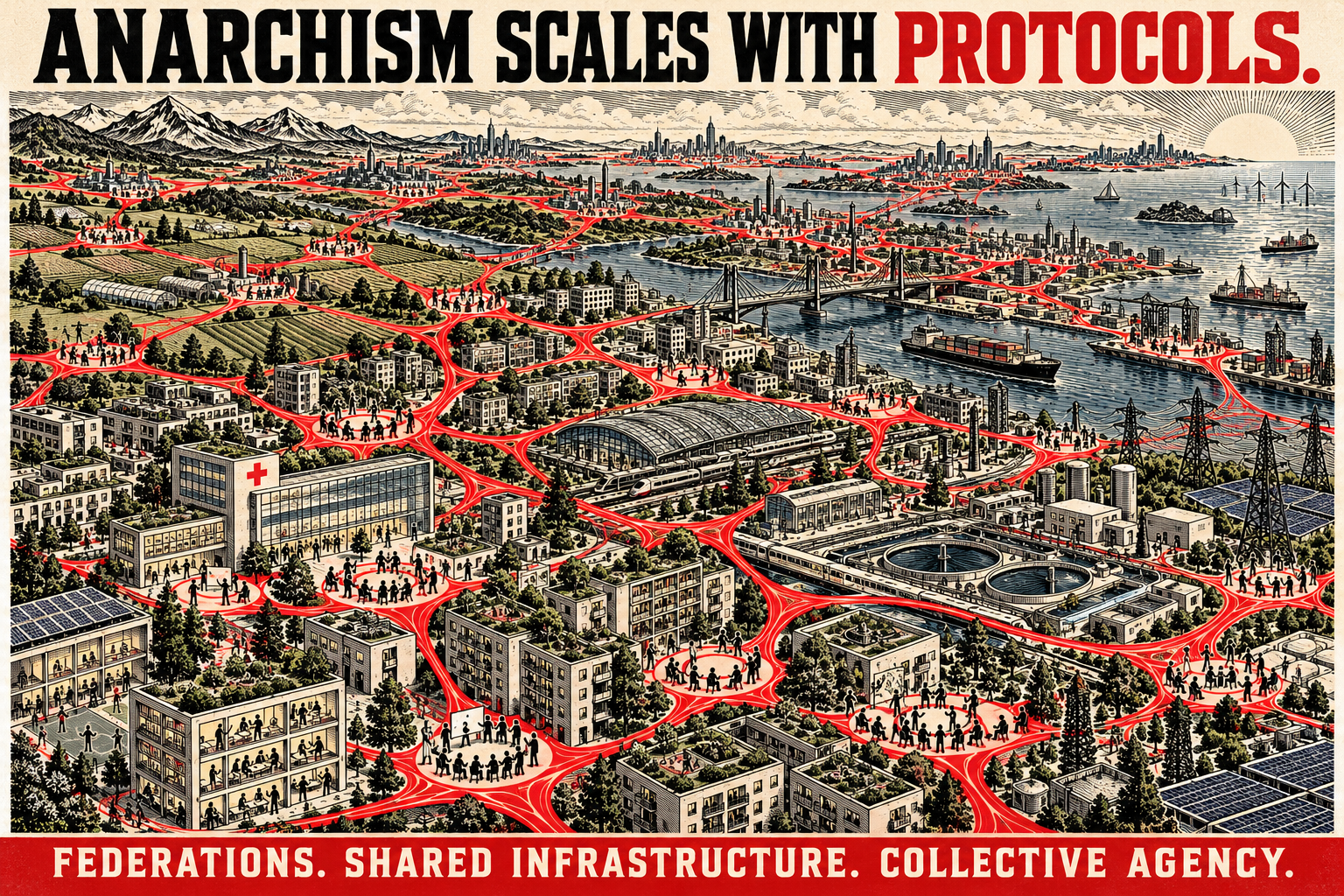
A whole society, coordinated without a ruling caste. That is the scale this lesson draws.
Illustration · the pictures here are drawn arguments, not evidence.
Listen — four voices, no charge
Press play before you read a word.
The seal on the wall argues with the record in the basement, the ledger that thinks it decides, and the assembly that has to live with the result. Turn Follow the page on and it scrolls to whatever's being discussed; tap any line of the transcript to jump there.
Lesson 20 · credentialism
Certified.
Not sacred.
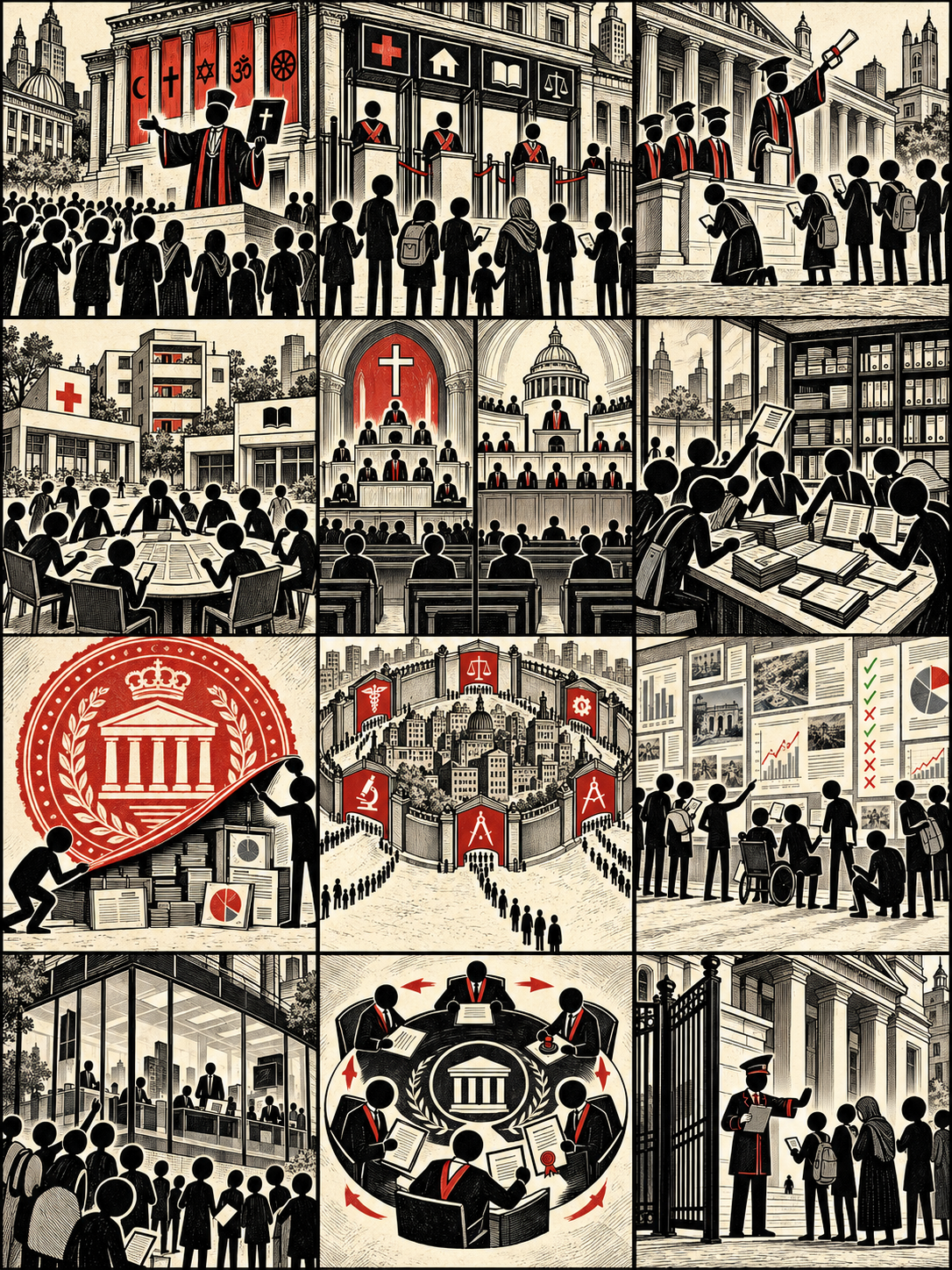
Separate church and state? Start with the demand for unquestioning faith. A secular title can still demand religious obedience.
A FUCKING ANSWER.
New robes.
Same demand
for faith.
Separating church and state means little if the state reproduces the relationship: an authorized caste interprets the truth, controls access to help, judges your worthiness, and expects deference in return.
In this critique, the professional title takes the place of ordination. The institution guards the doctrine. The application becomes a ritual of deservingness. Meagre provision is presented as benevolence, and the person seeking help is expected to be grateful.
Public services are not alms. People are not supplicants. Access to care, shelter, and a dignified life should not depend on performing obedience for a gatekeeper.
That is the church-state argument at the heart of this property: removing religious language does not, by itself, remove the machinery of faith and submission.
Keep your fucking benevolence. Give people agency, inspectable evidence, and power over the institutions that govern their lives.
A political manifesto
Credentialism is
a faith system.
That is the charge: when an institution asks us to accept its seal in place of inspectable evidence, it turns authority into belief. "Trust the professional" becomes a command to stop asking questions.
The issue reaches across professions. Who controls entry? Who decides whose knowledge counts? Who defines acceptable evidence? Who judges a complaint when the profession itself is on trial?
Calling something "evidence-based" is not evidence that its practitioners follow the evidence. Show the methods. Show the outcomes. Show the failures. Let the people affected challenge all three.
You don't get exclusive authority over people's lives and immunity from their scrutiny.
Authority certifies authority.
A model of the cartel logic this project challenges: the same circle controls entry, legitimacy, judgment, and protection.
We admit you.
The institution decides who can cross the gate.
We certify you.
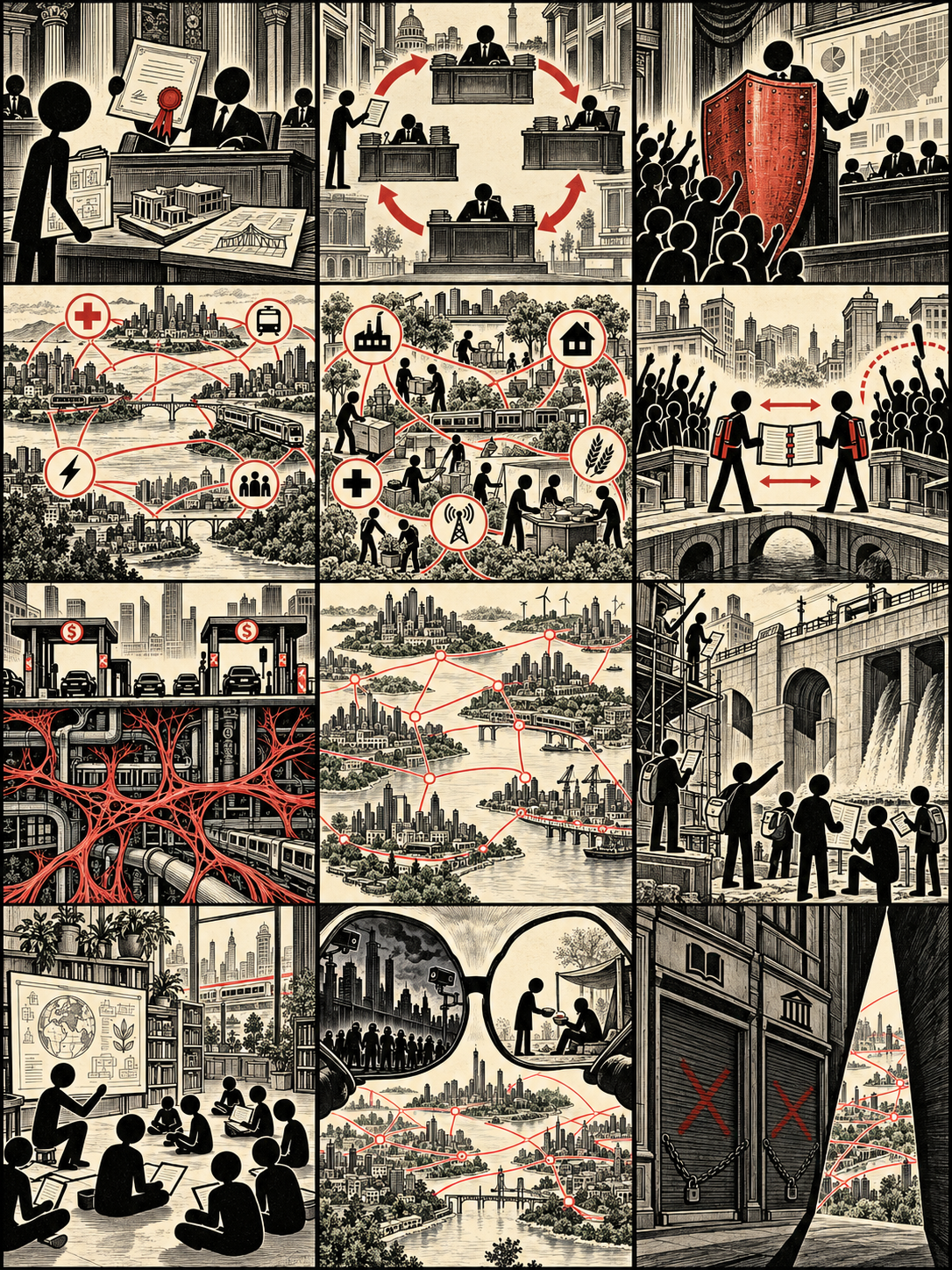
The seal becomes a shortcut for credibility.
We judge you.
The challenge returns to the same professional circle.
You trust us.
The public is asked to accept the result as protection.
doesn't answer
"Who holds you accountable?"
Anarchism scales
with protocols.
Federations. Shared infrastructure. Collective agency. A society coordinating without surrendering its decisions to a ruling caste.
Reducing anarchism to neighbourly kindness strips it of societal scale. Mutual aid includes the capacity to organize production, housing, care, transport, communications, and distribution through federations. Local agency and large-scale coordination belong in the same picture.
Protocols make commitments legible: how groups decide, share resources, resolve disputes, delegate a limited task, recall a delegate, and revise an agreement. Federation connects autonomous groups without turning their coordination into a new sovereign.
The fascia is the central metaphor here: the living connective tissue through which a society cooperates. The argument is that this capacity already exists in shared knowledge, cooperative organization, and distributed coordination. Capitalist ownership and institutional gatekeeping can capture its output and restrict the agency of the people doing the work.
These practices do not make every network an anarchist institution. They establish that coordination without one commanding centre is a present capacity, not political science fiction. The question is who controls it, who benefits, and who can refuse.
Anarchism is not a bicycle workshop beneath a cathedral of power. It challenges who owns the cathedral, who controls the infrastructure, and who gets to decide.
| CREDENTIALISM / THE CRITIQUE | ANARCHISM / THE ALTERNATIVE |
|---|---|
| Authority granted from above. | Trust earned through demonstrated practice. |
| Knowledge enclosed behind a gate. | Knowledge shared through teaching and cooperation. |
| Status treated as permission to command. | Expertise informs decisions; it does not own them. |
| Services delivered as benevolence. | Federated provision governed by the people involved. |
| Scrutiny controlled by the institution. | Open methods, independent challenge, and community accountability. |
Anarchism does not ask you to stop learning.
It asks why learning should make anyone your master.
Erase the name.
Keep the machinery.
One caricature makes anarchism synonymous with violence. Another grants it kindness but denies it organizational power. Both remove federation, protocols, and collective agency from the picture.
The Axes' Erased Axis essay argues that repression and exclusion narrowed the channels through which the anarchist tradition could be heard. This property extends that critique to imagery: showing the state at societal scale and anarchism at workshop scale quietly preselects who looks capable of organizing society.
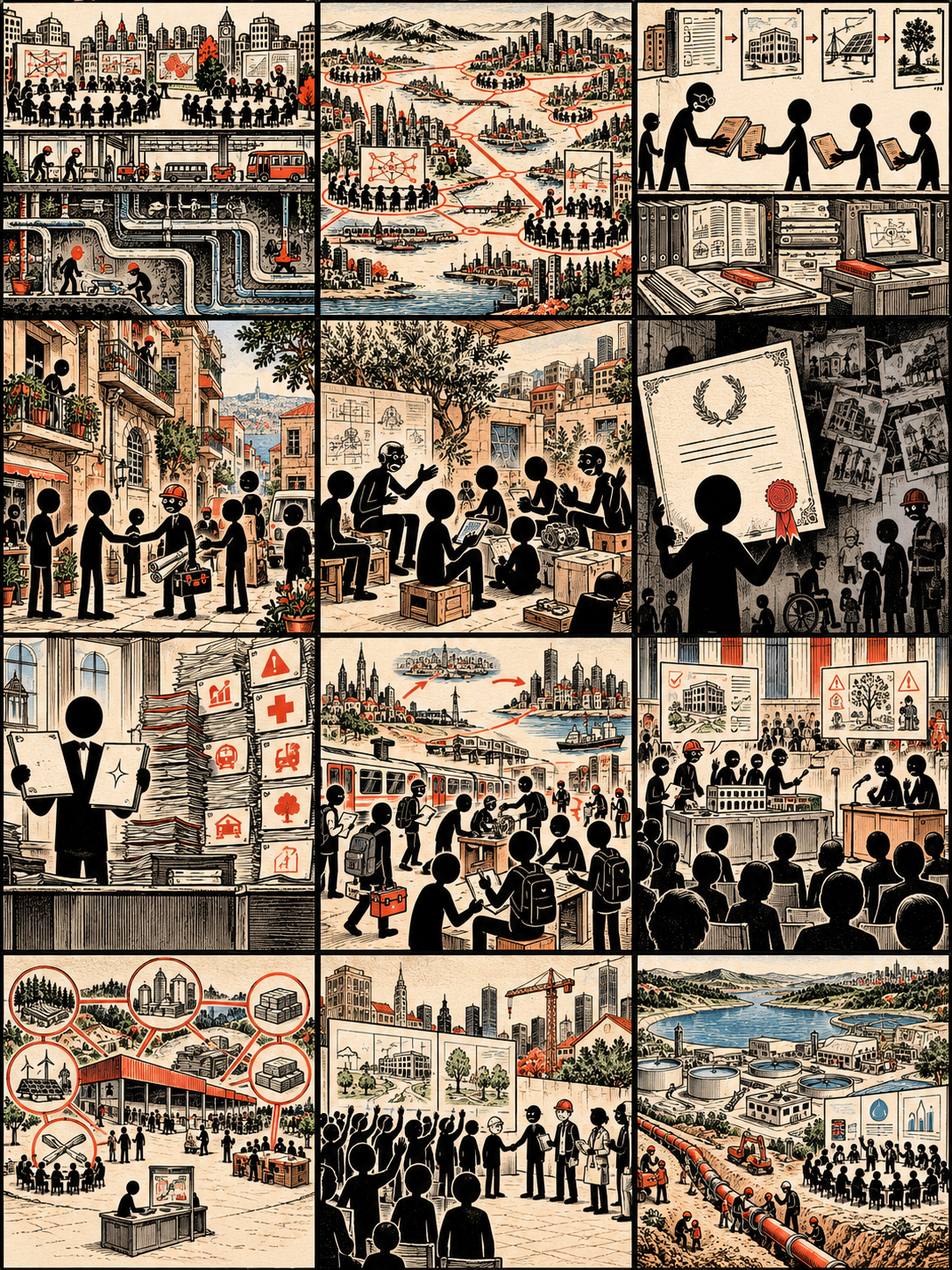
Ownership and control are separate questions. Its layered-system argument supplies a further question: must providing a service entitle its provider to control the whole system beneath it?
Draw the federation. Draw the protocols. Draw the people exercising agency across the whole system.
The certificate travels.
Do the consequences?
Trust needs a traceable history: where knowledge came from, who taught it, how it was exercised, who benefited, who was harmed, and what happened afterward. A network of people can preserve that history and challenge a person's account of their own competence.
The founding observation behind this project comes from the author's experience in downtown Beirut: asking someone's last name opened a network of relationships and people who could vouch for their work. The name was an entry into a history. It was not the evidence by itself.
Indigenous community-held and oral knowledge traditions also inform this emphasis on relationships, transmission, and responsibility. Those traditions are distinct; this project does not speak for them or collapse them into a single system.
Our indictment of credentialism is that institutional approval can obscure the record it is supposed to establish. A title remains visible while the people who experienced someone's failures disappear from the assessment.
Responsibility has three parts.
| WHAT MUST BE EXAMINED | THE QUESTION THAT FOLLOWS |
|---|---|
| Action | What did you do, and who bore the consequences? |
| Inaction | What did you fail to do when intervention was needed? |
| Response | When challenged, did you explain, repair, learn, or hide? |
A clean file can conceal a trail of abandoned people. An administrator who avoids every difficult decision can protect their career while leaving others to carry the damage. Accountability must follow the decisions that were ducked as well as those that were made.
Talent circulates through federation.
Each community needs access to capability. It can develop talent locally, welcome people with needed skills, or exchange services with other communities. Federation connects those capacities and carries the record of work across them.
The network must hear conflicting accounts, let newcomers demonstrate their abilities, and allow reputations to be challenged and repaired. Neither family membership nor institutional membership can replace scrutiny.
The community commissions.
The federation coordinates.
Finance serves.
A society should be financed by its commitments to one another, not governed by its debts to a creditor.
Start with the people who will live with the result. They establish the need, agree on the project, commit resources, and commission the work. Finance answers to that mandate.
Community sponsorship includes labour, materials, land access, equipment, knowledge, and commitments from other communities. Money can help account for contributions and exchange resources. It does not have to become the permission slip for collective action.
| CREDITOR-LED AUTHORITY | COMMUNITY SPONSORSHIP |
|---|---|
| The project must fit the lender's priorities. | Resources are assembled around a community-defined need. |
| Financial approval establishes permission. | The affected people authorize the work. |
| The lender's return sets the test. | Delivery, consequences, and repair remain open to scrutiny. |
| Outside finance dictates the mandate. | Outside finance must fit the mandate already agreed. |
A project, from need to responsibility.
For an illustrative water project, residents and workers establish the need and the standards of delivery. Local groups commit available resources. Partner communities supply missing expertise or materials through agreed exchanges. Delegates coordinate defined tasks and remain recallable. Costs, progress, failures, and corrective work stay visible to the people affected.
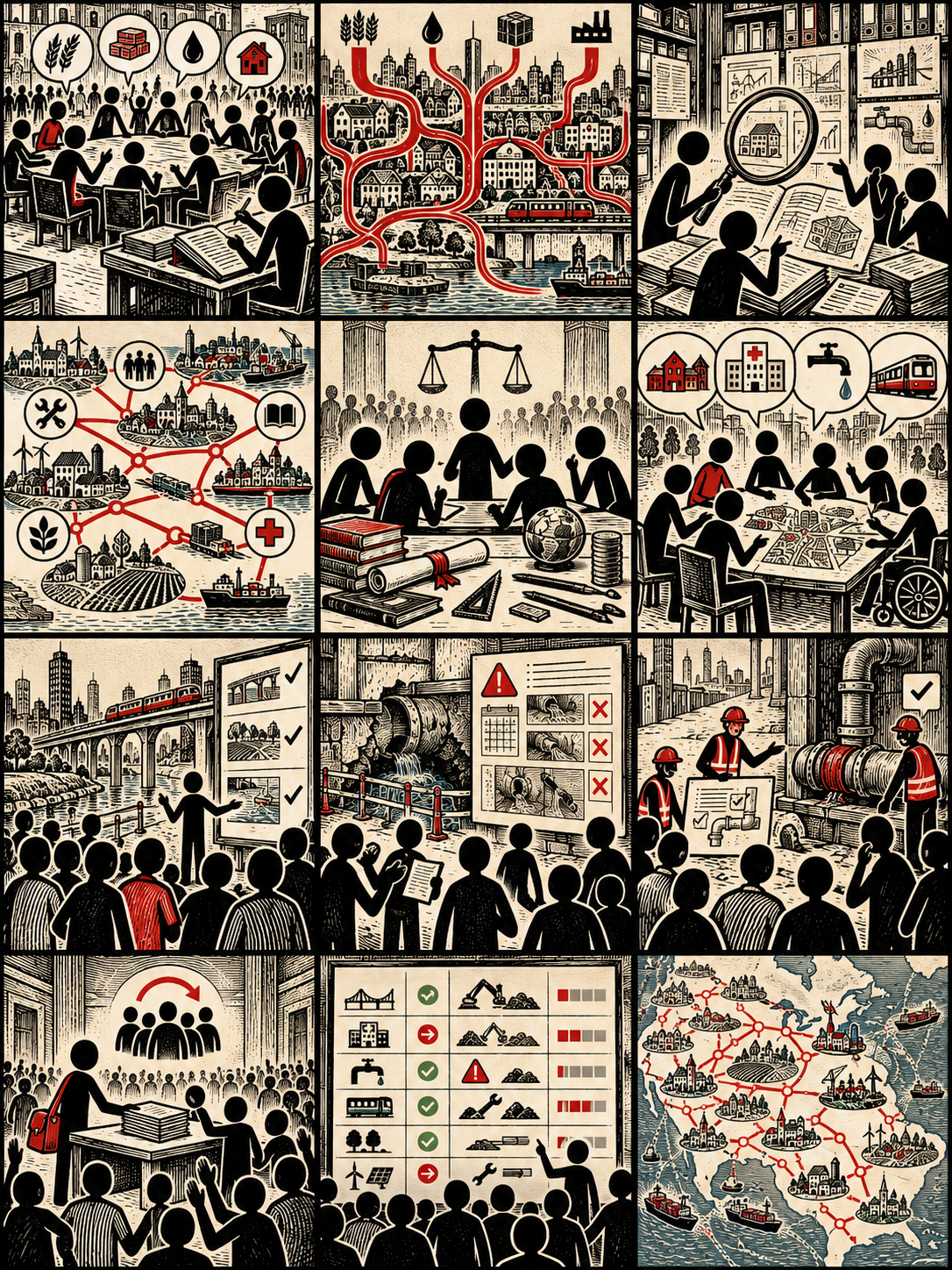
Scarcity still requires choices. Disputes still require a process. Outside credit can still be considered. The reversal is in who makes the decision: a financial intermediary performs a function within the federation; it does not acquire sovereignty over it.
Resources sustain the organism.
They do not purchase the right to rule it.
Take away the title.
What is left?
Think of an institution asking for your trust. Check only what you can actually inspect.
The argument, illustrated.
Anarchism is the fascia.
Federation is how it scales.
Communities identify needs, assemble talent, commit resources, and federate to meet what they cannot provide alone. Knowledge carries a traceable history. Responsibility follows action, inaction, and response.
Money serves that cooperation. Credentials document learning. Neither grants dominion over the people.
Agency stays with the people whose lives are at stake.
Continue on The Axes
This is a political argument, not a claim that every credentialed result is false. The Beirut account is the author's own observation. The illustrations are AI-generated editorial drawings: they depict ideas, not events, places or people, and nothing on this page rests on them. The accountability check runs only in your browser; nothing is sent or stored. Related lessons: The erased axis, The stack, The chart.