Some sentences cannot be fact-checked. Not because they are false — because they are not claims yet. “He is turning Canada communist” names no owner, no decision, no document. Start from the artefact below, put it on the grid, and it resolves into two questions that each have a public record behind them. This lesson does the relocation, and then hands the record to someone who will read it.
Listen
Four voices, seven minutes.
The whole lesson, spoken. Turn Follow the page on and it scrolls the article to whatever is being discussed; tap any line of the transcript to jump there.
The specimen
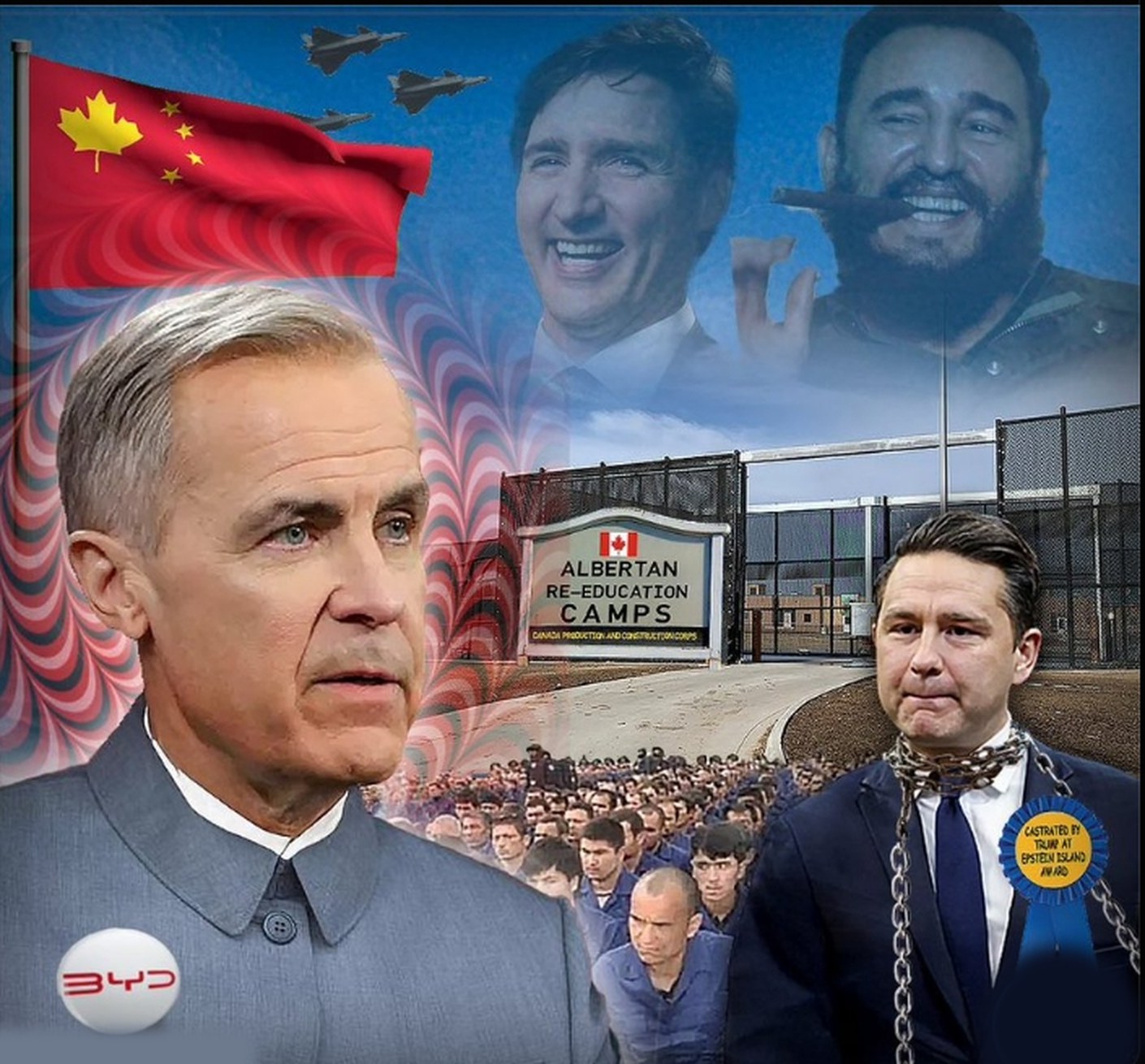
This is not evidence. It is a symptom.
There are millions of these. This one went around in September 2026. Who made it does not matter, whether any of it is true does not matter, and it is not an argument anyone could answer. It is worth looking at for exactly one reason: it is what a political claim looks like when the person making it has no coordinates to put it on.
Tap to open it at full size.
Six things are on the table at once. Pull them apart and each one is reaching for a different accusation — and not one of them names an owner, a decision, or a document.
01 · The flag
The maple leaf is being replaced by the star. That is a claim about allegiance, wearing the costume of a claim about ownership. There is no ownership question inside it at all.
02 · The bloodline
A paternity innuendo standing in for a policy argument. Unfalsifiable by construction — no record settles it, and no answer would explain a single decision either man made.
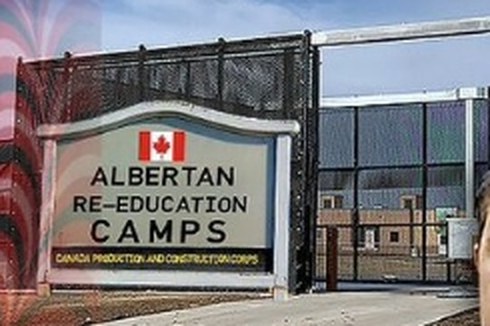
03 · The camps
Signage invented, fence borrowed. Re-education is the signature violence of the collective, high-control corner — the one corner this government is demonstrably not in.
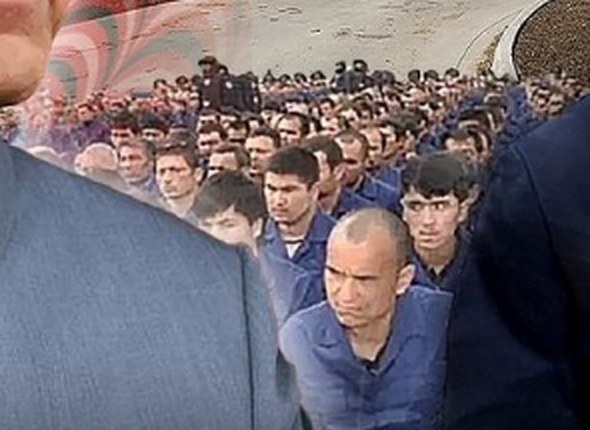
04 · The detainees
Real people, in a real detention system, conscripted as set dressing. This is the panel that costs something: it spends an atrocity to decorate a guess.
05 · The costume
A Mao collar and a Chinese car badge. The figure the collage wants to convict, dressed in the only outfit a single axis owns for the idea of too much state.
06 · The other one
The opposition leader in chains, owned by a foreign president. Watch what just happened: one leader is accused of foreign capture and the other is drawn as foreign property. On a line those are opposite ends. They are the same accusation.
Nothing in it is quite a lie. Nothing in it is checkable either. That is the condition — and it is not a stupidity problem, it is a map problem. Every one of those six panels is groping for the same thing and has no axis to put it on.
Ask the question that separates a claim from a noise: what record would settle this? For the first three there is no answer, because “communist” is not being used to describe who owns anything. It is being used to mark a side. A word doing that job has no evidence class attached to it, which is why the collage can absorb any week’s news without ever updating.
The instrument
One dot, two coordinate systems
Below are two positions. What the collage asserts about the Canadian government, and what the public record shows it doing. On the grid they sit on the same side of one axis and opposite sides of the other. Then collapse the grid to the left/right line and watch which of those two facts the line is able to carry.
Fig. 1 — the relocationTwo axes · both coordinates visible
high controllow controlcollectiveprivateauthoritarian communismauthoritarian fascismlibertarian socialismlibertarian capitalism
On the grid, the two positions agree about direction on the vertical. Both put this government in the upper half — both are, underneath everything else, making a claim about concentrated decision-making. They differ on magnitude there, and they point in flatly opposite directions on ownership. Two coordinates, two different kinds of disagreement, both of them narrow enough to check.
Collapse to the line and only one of those two facts survives. The sixty-two-point ownership disagreement is still there — but it is now the whole reading, reported as the total relationship between the two positions. The shared vertical claim is not reduced. It is deleted, because the line has no up. What the line hands you is a picture of two opposites, built by discarding the thing they had in common.
That is the whole mechanism of the error. The collage has a real alarm about concentrated decision-making and no axis to put it on, so the alarm gets smuggled in as an ownership claim — and the only ownership claim extreme enough to carry that much alarm is “communist.” The word is not a description. It is the overflow.
The output
Two questions, two evidence classes
Here is what the relocation produces. One unfalsifiable sentence becomes two propositions, and each one names the kind of document that settles it.
Is ownership moving toward collective hands, or away?
Horizontal · the axis the line kept
Not a question about rhetoric. A question about title, concession and control of assets — the thing the word “communist” purports to be about.
Four largest airports — opened to private investment via long-term concessions, announced 15 September 2026; enabling legislation assented 18 June 2026. Land and underlying assets stay in public hands.
Direction of travel — outward.
Has decision-making been concentrated and insulated from review?
Vertical · the axis the line erases
Not a question about who is in office. A question about where a decision is made, and whether anything downstream of it can say no.
Building Canada Act — royal assent 26 June 2025. Cabinet may add a project to Schedule 1 by order.
Section 6(1) — for a listed project, every determination and finding required for an authorisation “is deemed to be made or formed … in favour of permitting the project.”
Schedule 2 — twelve Acts and seven regulations whose approvals the designation absorbs.
On the axis the collage is shouting about, it is pointing the wrong way. On the axis it has no word for, it is pointing at something real.
That is a result you can only get with two axes. The line can produce only one verdict per claim, so it produces the wrong one, loudly.
The handoff
A claim is not a finding. Somebody still has to read the record.
This site plots positions. It does not adjudicate them — that is a different instrument, and the relocation is what makes the adjudication possible in the first place. The control-axis question above has a public answer, and it is stranger than either the collage or its critics assumed: fourteen months after the designation power passed, Schedule 1 is still empty, and the first entry is days away.