Case study · two populations, one system

Zionism on the axes

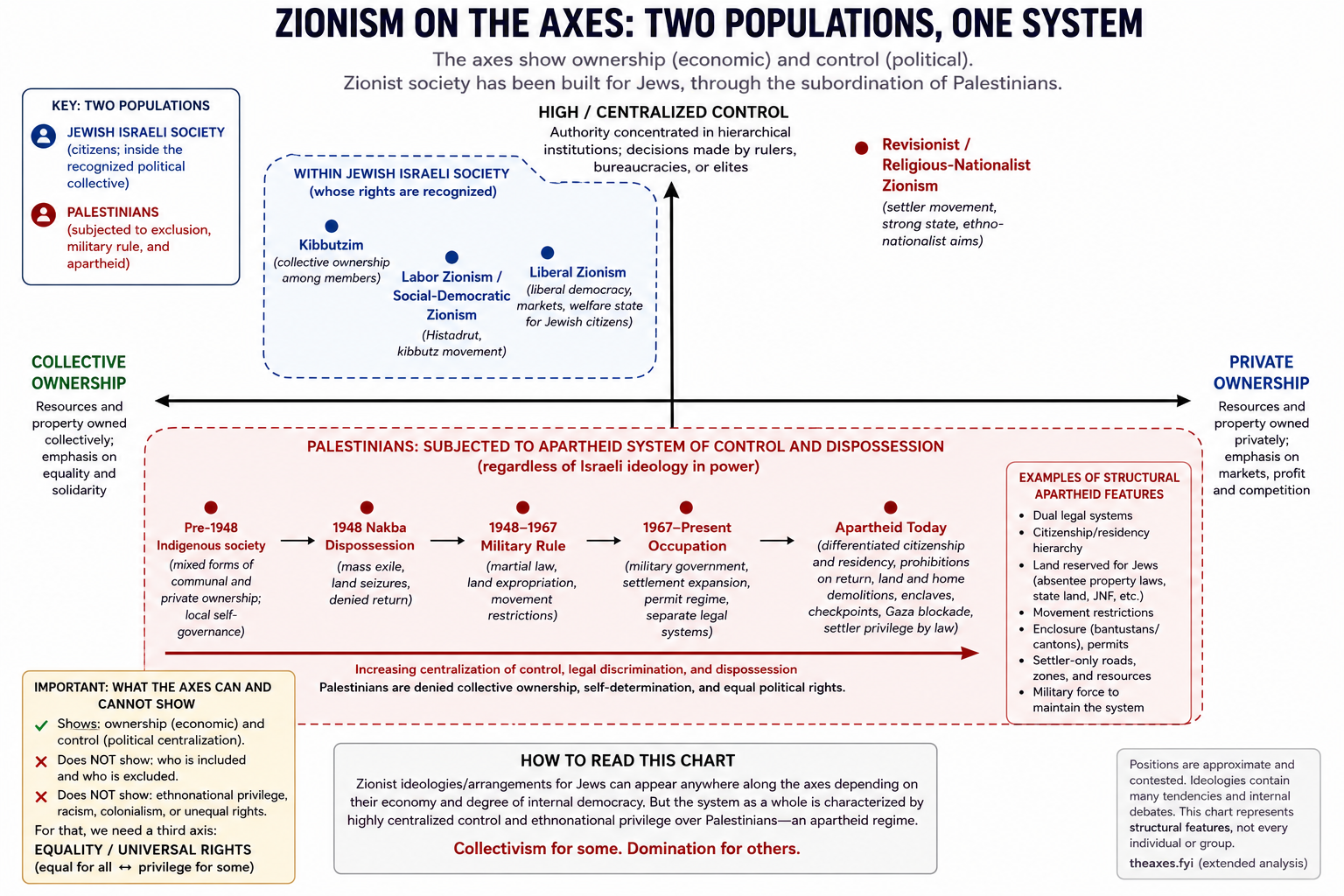
“Liberal,” “Labor,” “kibbutz” and “Revisionist” describe differences inside the society whose rights are recognized. They do not describe different systems for Palestinians. Across those self-attributed labels, Palestinians encounter the same governing structure: unequal rights, dispossession and centralized control.

Chart plotting kibbutzim, Labor Zionism, Liberal Zionism and Revisionist Zionism by ownership and centralized control, while showing the historical system of dispossession and unequal control imposed on Palestinians.
Tap the chart to open it at full resolution.

The blue labels are internal arrangements

Kibbutzim can organize property collectively. Labor Zionism can describe itself as social-democratic. Liberal Zionism can support markets, elections and welfare. Revisionist Zionism can advocate a stronger nationalist state. Those labels locate tendencies within Jewish Israeli society; they do not define the rights of everyone governed by the state.

The red field is the shared relationship

For Palestinians, the relevant structure is not which Zionist tendency governs internally. It is the system operating across citizenship, residency, land, movement, military force and political power. Changes among Zionist labels can alter administration without ending the underlying relation of domination.

Collectivism for some. Liberalism for some. One system of domination for Palestinians.

The axes show ownership and centralization. They do not, by themselves, show who belongs, who is excluded, or whose rights count. This case therefore requires a third question: equal universal rights, or legally structured privilege?