An employer normally decides where you are, when you work, how you work, what you work on, who you work with, whether you can be interrupted, what you may wear, when you may eat, what the arrangement costs you, and where you are permitted to live. Working from home moves one of those. The argument of the last six years has been about that one, as though it were the set — which is how a company can grant remote work and concede no autonomy whatsoever.
Four gates · Five rungs · Narrated
Watch first, if you like
The two-minute version
The opening argument, set to music: what an employer decides, how much of it working from home actually moves, and why four of the ten have to move in order.
Listen
Four voices, eleven minutes.
The whole lesson, spoken. Turn Follow the page on and it scrolls the article to whatever is being discussed; tap any line of the transcript to jump there.
The decomposition
Ten decisions, one word
“Remote work” is a single term covering a bundle of separate decisions, each of which can be held by the employer or by the worker, independently of the others. Pull the bundle apart and there are ten. Four of them sit on the path from an office to genuine agency — they are the ones that have to move, in order, for anything to change. The other six can be handed over at any time, in any combination, and frequently are, because they are cheap.
Fig. 1 — ten decisionsOne moved
01PlaceWhere you areGate 1
02TimeWhen you workGate 2
03ProcessHow you workGate 3
04TermsWhat you work on, and with whomGate 4
05AttentionWhether you can be interruptedOff the path
06BodyWhat you wear, when you eatOff the path
07SocialWhen contact happensOff the path
08EconomicWhat it costs youOff the path
09GeographicWhere you may liveOff the path
10BoundaryWhen you are off workOff the path
Notice what the list does to the usual argument. The case normally made for working from home is assembled almost entirely out of the six cheap keys — the commute, the lunches, the clothes, the noise, the interruptions. Those are real, and they are also the ones an employer can concede without surrendering a single decision about the work. Every item on the standard pro-remote list is an item the institution can grant and still run the place exactly as before.
The instrument
The ladder, and the gates on it
The four path keys are not a checklist. They are gates, and they open in order. Time without place is a shift pattern. Process without time is a deadline you cannot schedule around. Each rung below requires every key beneath it, and nothing a company does with the other six moves you up even one step.
Tap a rung to see what it actually requires. Then use the last control.
Fig. 2 — the continuumRung 4 selected · arrangement intact
Why the obvious scoring fails
A total is the same mistake in a nicer font
The tempting way to measure this is to count. Ten dimensions, add up how many you hold, call it an autonomy score. Do that and the instrument reproduces the exact error it was built to expose — because it lets six cheap keys outvote the four that decide anything.
Counted
Seven out of ten
A developer at home. She eats when she likes, wears what she likes, has no commute, is never interrupted before noon, is not expected to be visibly present to anyone, answers messages when she gets to them, and lives three provinces from the office. Seven keys held. On a total, she scores higher than almost anyone in the building.
Score 7/10 — “highly autonomous”
Gated
Rung two
Her hours are fixed and monitored. Her method is specified by a process she had no part in setting. Her work is assigned. Place moved; time, process and terms did not. She is on the second rung of five, holding six keys that the second rung does not require — which is the whole shape of the modern arrangement.
Rung 2 of 5 — work from home
Both readings describe the same person accurately. Only one of them tells her what would have to change. A total says you are doing well; a gate says your hours are the next thing, and nothing you gain outside the four moves you. That is the difference between a score and an instrument.
The disguise
Choice is not control
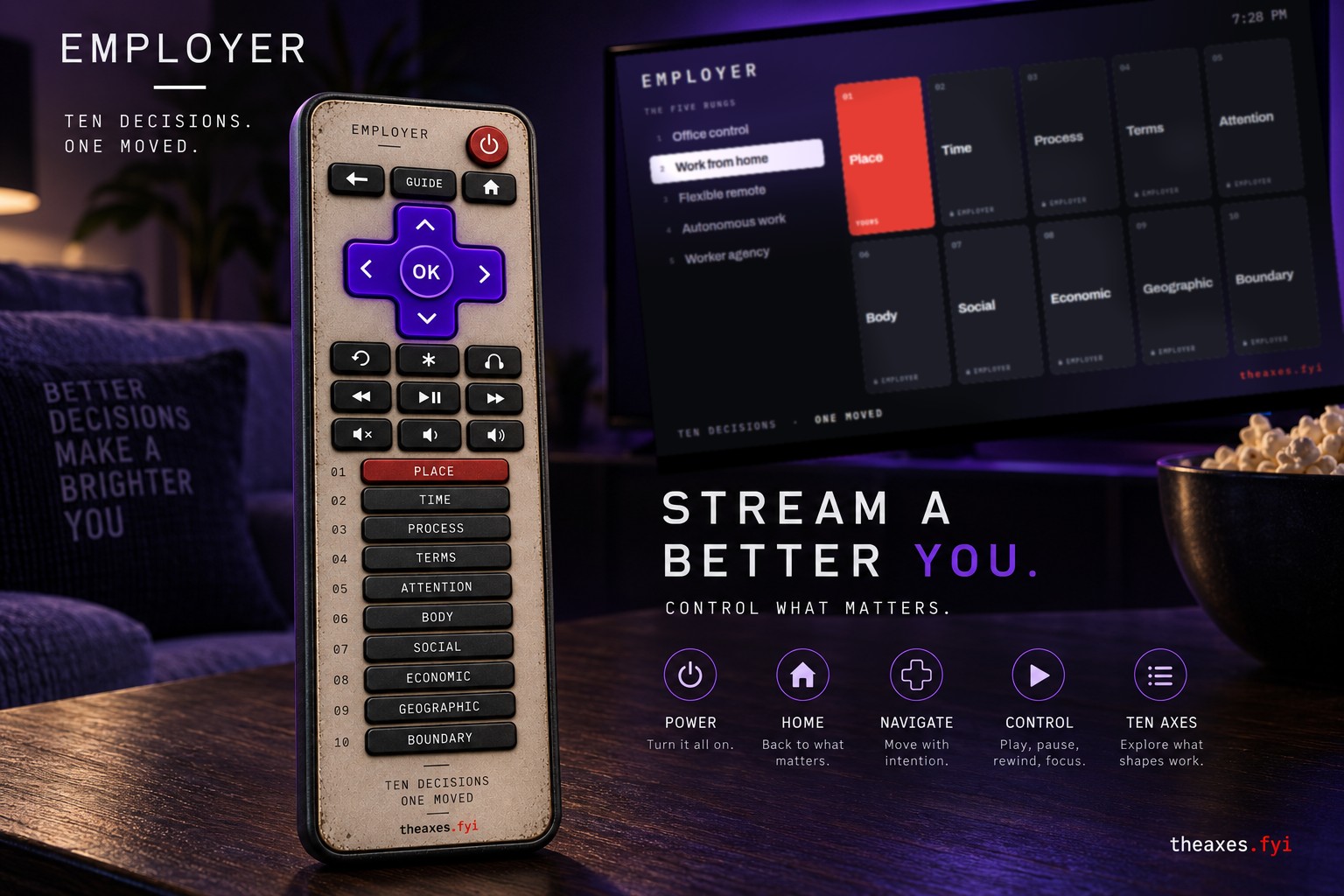
A remote is a real instrument of control. Twenty-odd buttons, instant response, finer granularity than most tools anyone owns. Pause, rewind, louder, quieter, skip, back — and every one of them answers the moment you press it. Nobody has ever felt powerless holding one.
And every one of those controls operates inside a catalogue you did not assemble, on a schedule you did not set, at a price you did not agree. You can pause anything. You cannot commission anything.
That gap is the most common disguise agency wears: fine-grained, satisfying, entirely genuine control over the inside of a thing, and none whatsoever over whether the thing exists or what is in it. It is not a trick, and the control is not fake. The boundary is simply somewhere other than where the buttons are.
Which is the shape of the arrangement this lesson is about. Real control over when you eat, what you wear, whether the camera is on, how the afternoon is spent — inside a job whose terms, methods and existence are set elsewhere. The six cheap keys are the volume knob. The ten sit on the same handset, underneath, in smaller type: not a different kind of button, a different side of the line — the side the catalogue gets chosen on.
Tap to open it at full size.
The disguise
“I don’t really care what’s on TV.”
Neither does the argument. The catalogue is not the point. The point is that twenty buttons of genuine control can sit on top of no control at all, and feel like plenty.
Control what matters tells you that what you are holding is the important part. Better decisions make a brighter you finishes the job: if it does not feel like enough, the thing to adjust is you.
Choice Is Not ControlBonus track · 4:17
“I can say yes. I can say no. I can change the hour — not the road.”
Lyrics
Verse 1
Twenty-odd buttons in my hand Pause, rewind, and understand Louder, quieter, skip it back Every press comes right on track Nobody feels small holding this Instant answer, perfect grip But the shelf was picked elsewhere The whole menu already there
Pre-Chorus
I can stop the frame I can change the pace I can move the day Just not the place
Chorus
The disguise Choice is not control The disguise Hold it, but you don’t own I can pause I can twist the dial But the line is drawn Where the buttons die
Verse 2
A camera on, a camera off What I wear, and when I talk How the afternoon gets spent Inside terms I never meant Finer grain, a grateful hold Tiny powers, clean and cold But the price was set upstream Not by me, not in my dream
Pre-Chorus
I can say yes I can say no I can change the hour Not the road
Chorus
The disguise Choice is not control The disguise Hold it, but you don’t own I can pause I can twist the dial But the line is drawn Where the buttons die
Bridge
That gap is the lesson The shape of the deal One hand on the volume One hand never real Inside the thing I look free Outside the thing It’s chosen for me
Final Chorus
The disguise Choice is not control The disguise Hold it, but you don’t own I can pause I can twist the dial But the line is drawn Where the buttons die The disguise Choice is not control The disguise Hold it, but you don’t own
Words: Frank Francoeur. The recording above is an earlier take and sings a different second verse and chorus.
The part that is usually left out
A transferred decision and a lent one look identical until the memo
Every rung above the first describes a decision that used to sit with the institution and now sits with the worker. The ladder says nothing about who can move it back — and on that question the last six years are unambiguous. Place was lent, not transferred. It was returned on request, by memo, to people whose job titles, duties and output had not changed, and the number of them who could decline was approximately none.
So the reading needs a second term. Not just how many decisions have moved, but whether anything holds them where they are. A contract clause. A union agreement. A labour market in which you can leave. Absent one of those, a rung is a courtesy, and the honest way to report it is: rung three, on loan.
This is also the answer to why employers adopted the vocabulary so readily. “Remote work” was the cheapest possible concession: one key, revocable, in exchange for a workforce that described itself as having won something. The press coverage treated a lease as a transfer of title, and the recall notices of 2023 onward were reported as a reversal of policy rather than as the ordinary exercise of a right that had never moved.
What would make it a transfer
The same thing that makes any other decision stick: it stops being the employer's to make. Written into the terms of employment rather than a handbook. Bargained collectively rather than granted individually. Attached to the role rather than the manager. Each of those converts a rung from something you are permitted to stand on into something you hold — and each of them is resisted far harder than the thing itself, which is the tell.
Rung Three on LoanBonus track · 3:20
“If they can take the rung by memo, you never held the place.”
Lyrics
Intro
Same job. Same duties. One memo—who holds the key?
Verse
Remote work looked like agency, A choice moved closer, worker-held. Then came the note: return to office. Same hands, same task, same output dealt. One memo lands, the door swings back, And almost nobody can refuse. If they can call the choice right back, Was it yours to hold—or theirs to loan?
Call and Response
Who can take it back? The institution! Who holds the key? Check the fine print! Can you say no? Can you walk away? If not, that rung was lent today.
Verse
A contract clause, a union line, A real choice to leave behind— Those are the tests that make it yours, Not just a pause from office doors.
Chorus
Rung three—on loan! Looks like yours till the memo comes. Rung three—on loan! If they recall it, where's your say? Rung three—on loan! Autonomy can wear a borrowed face. If they can take the rung by memo, You never held the place.
Bridge
Agency is more than choosing From a list they can erase. Who can reverse the decision? Who can make you leave your place?
Chorus
Rung three—on loan! Looks like yours till the memo comes. Rung three—on loan! If they recall it, where's your say? Rung three—on loan! Autonomy can wear a borrowed face. If they can take the rung by memo, You never held the place.
Outro
Same job. Same duties. One memo tells the truth. If the key comes back to them, The rung was never yours to lose.
Words: Frank Francoeur.
Rung Three on Loan — the spoken versionAdditional cut · 2:52
Not the song. A spoken piece under the same title, and its own words: a transferred decision and a lent one look identical until the memo arrives — the decision wasn’t transferred, it was lent.
Every decision transferred from the institution to the worker expands the worker's sphere of agency. The word “transferred” is carrying the entire sentence.
A company can concede location, absorb the office savings, keep the other nine decisions, and recall the tenth whenever it chooses. That is not a step along the continuum. It is the first rung, with a nicer commute.
First RungThe closing track · 4:00
The last thirty seconds are the paragraph above, read out. The song got there first.
Lyrics
Verse 1
They gave you the corner And took the corner office Called it a balance Called it a win You keep the same five meetings Just in a different chair Same ten decisions One gets parked again
Pre-Chorus
Count the savings in the glass Count the distance in the gas If they want the room, they can have it If they want the view, they can stash it
Chorus
That's the first rung With a nicer commute First rung, first rung Still calling it truth They can keep the other nine Keep the keys, keep the shine First rung With a nicer commute
Verse 2
They'll say it's freedom While they rewrite the leash Your name stays on the door Just moved out of reach And when they need that tenth one They'll pull it back like rent A button they can press A promise they can bend
Pre-Chorus
Count the savings in the glass Count the distance in the gas If they want the room, they can have it If they want the view, they can stash it
Chorus
That's the first rung With a nicer commute First rung, first rung Still calling it truth They can keep the other nine Keep the keys, keep the shine First rung With a nicer commute
Bridge
Not a path Not a shift Just a ladder With a gift You move your desk They move the power One small step One longer hour
Final Chorus
That's the first rung With a nicer commute First rung, first rung Still calling it truth They can keep the other nine Keep the keys, keep the shine First rung With a nicer commute
Coda
A company can concede location, absorb the office savings, keep the other nine decisions, and recall the tenth whenever it chooses That is not a step along the continuum It is the first rung, with a nicer commute
Words: Frank Francoeur.
Place yourself
Twenty statements, one question, and the rung you are actually on
Keyring runs the ten keys against your own job. It reports which keys you hold, which rung the gates put you on, and how many of the keys you hold are not on the path at all — the ones you were given instead. The last question is the one about the memo, and it decides whether your rung is reported as yours or as a loan.
Each tile is ready to post with a link back to the lesson. Choose the part of the argument you want to carry.
The ten keys are a decomposition, not a survey instrument with published validity — they are the dimensions the single word “remote” is covering, and the gates are an argument about which of them are load-bearing. The ladder's five rungs follow the ordinary usage of the terms: office control, work from home, flexible remote work, autonomous work, worker agency. Lesson 06 establishes why the control axis has a current of its own; lesson 15 shows what happens when a claim has no axis to sit on. The grid's vertical axis is this one, scaled down from a state to a firm — which is the point of having an axis rather than a line.