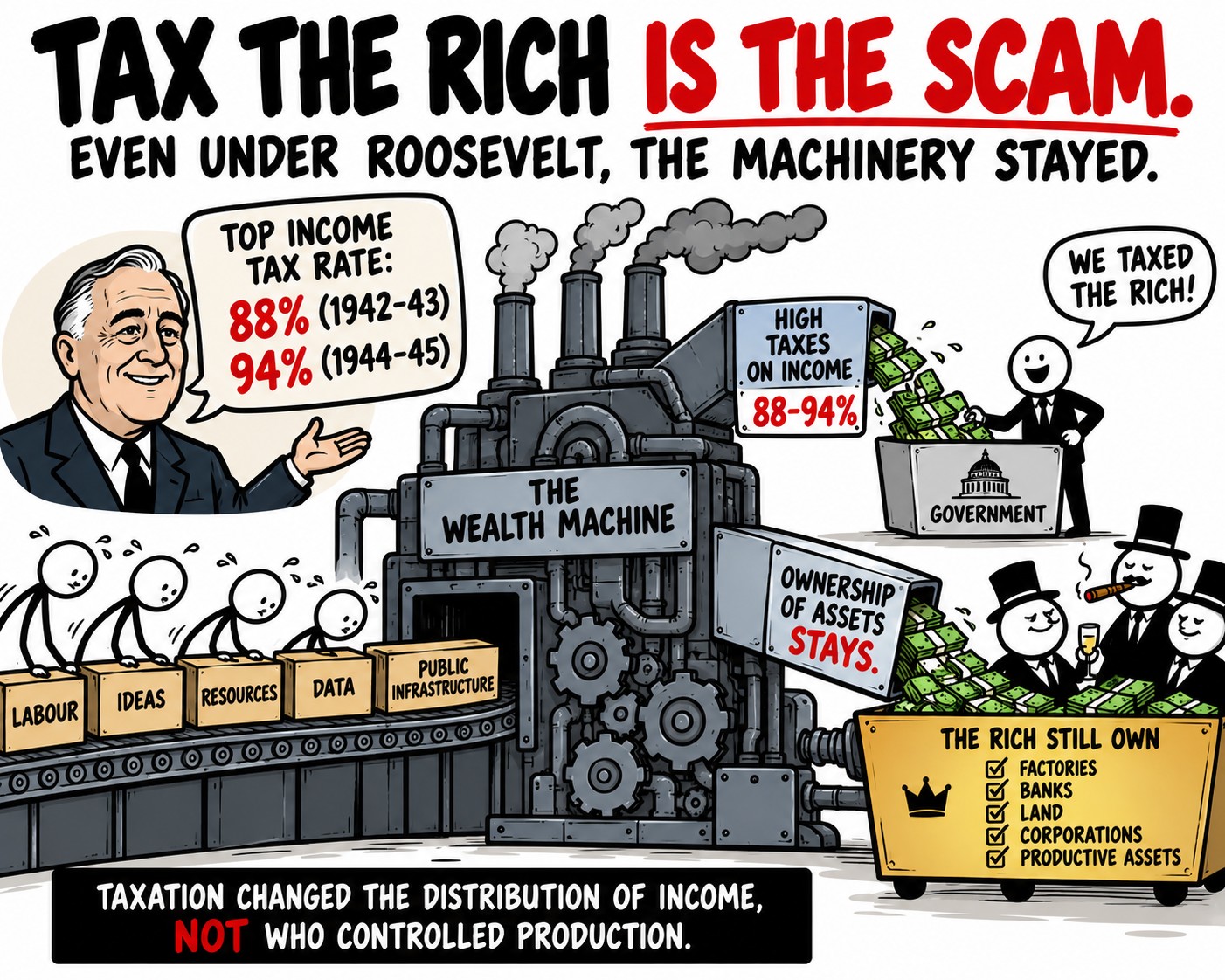
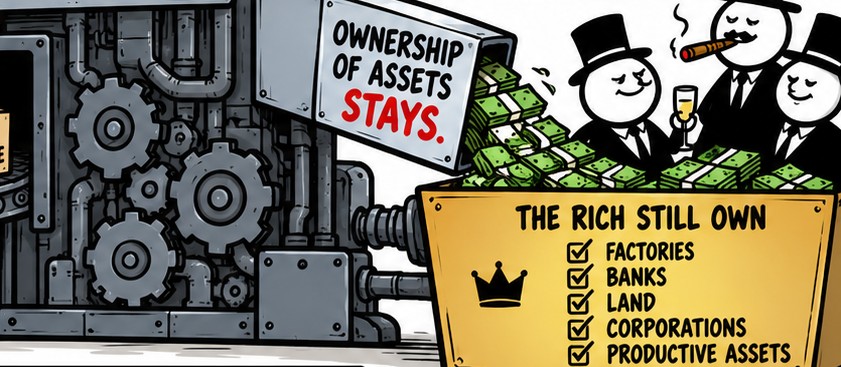
This is what went around. Look at the whole thing before anyone tells you what it means.
Tap to open the full infographic — it cycles through the full picture and its own details on its own above.
Listen — four voices, seven minutes, no charge
Press play before you read a word.
The whole lesson is spoken, both specimens included. Turn Follow the page on and it scrolls to whatever's being discussed; tap any line of the transcript to jump there.
Lesson 18 · a receipt is not a deed
The receipt
A panel went around arguing that taxing the rich is "the scam" — Roosevelt took 94% off the top bracket and the owners stayed the owners. The panel is right about that, and it is checking only one axis. A tax rate is a claim on a flow of income. A deed is a claim on title to an asset. They are not the same instrument, and a chart that reports only one of them can make the other one's entire movement disappear. This lesson puts both coordinates back and asks what the record actually shows moved.
The specimen
Correct about the deed. Silent about everything else.
It circulated in the usual way in October 2026 — no byline, built to be screenshotted whole. Every number in it checks out. The top bracket really did hit 88% in 1942, 94% in 1944. The rich really did keep the factories, the banks, the land. That half of the argument survives contact with the record intact.
Tap to open it at full size.
What the panel does not check is anything about the size of the claim it is depicting as weightless. "The machinery stayed" is true of the deed office and is being read — by the people sharing it approvingly and the people sharing it as proof taxation is theft either way — as if it settled the whole question of whether 1942 through 1945 changed anything at all. It changed the second-most centralized peacetime claim on private income in American history. The panel's own machine is doing that work in the picture and the caption never looks at it.
Four frames
The picture already drew both axes. It only labelled one.
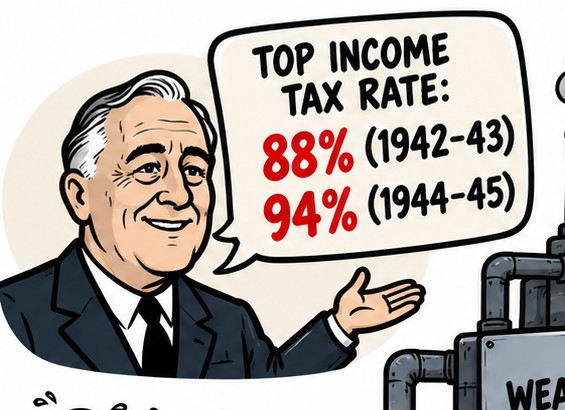
01 · The rate
Both numbers are real brackets, both on income above a threshold, neither anywhere near what anyone actually paid. A rate is a flow variable — it describes a percentage of what comes in this year, not a title to what already exists.
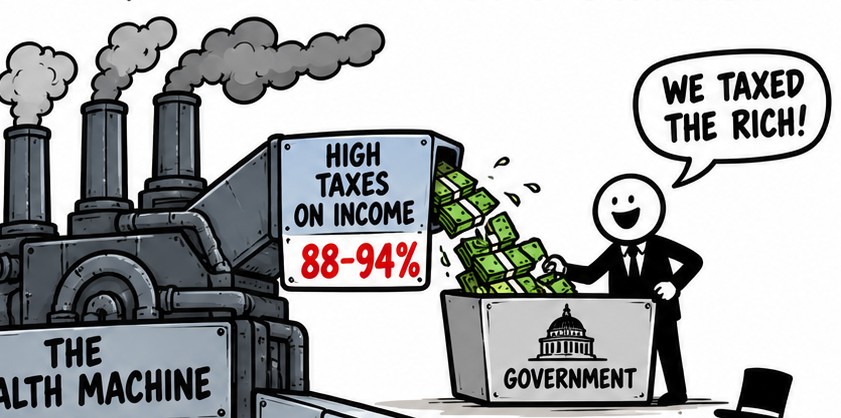
02 · The transfer
This is the part of the picture the caption is actually about: a slice of income flow redirected to the state. It is drawn correctly — and it is the single biggest thing that moved, which the caption spends zero words on.
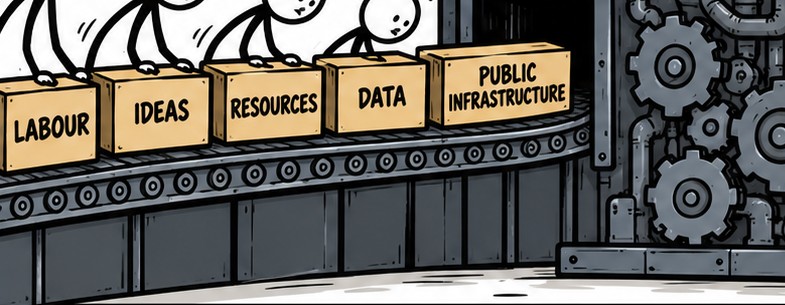
03 · The inputs
What the machine runs on. Nobody re-titled a single one of these boxes in 1942 — the panel is right that the inputs kept their owner. It is a different claim from whether the outputs kept their size.
04 · The deed
The one coordinate the panel checks, and checks correctly: no nationalization, anywhere, ever, in this story. Confirmed below against the actual wealth data — which is also the coordinate that moved the least.
The instrument
One starting point. Two readings of where it went.
Start both readings from the same place: the American economy in 1929, solidly private and moderately low-control by this grid's own terms. The imagined reading is the one both the panel's fans and its critics are arguing about without saying so — a big slide toward collective ownership, because that is the only vocabulary either side has for "the state took a lot of money." The record is where the documented facts actually place 1945.
Fig. 1 — the receiptTwo axes · both coordinates visible
high controllow controlcollectiveprivateauthoritarian communismauthoritarian fascismlibertarian socialismlibertarian capitalism
On the grid, the record's dot barely leaves the private column — title to factories, banks and land did not change hands. But it climbs the control axis hard: a 94% bracket, a wartime allocation board deciding who gets steel, a price board deciding what things cost, a labor board capping what a raise could be. None of that is a title question. All of it is a control question. The imagined reading has the opposite shape — a big slide left, almost no climb — because "tax the rich" and "it's practically communism" are both, underneath the disagreement, describing the same single horizontal axis.
Collapse to the ownership line and the record's dot and the imagined dot land close together — correctly, this time. That agreement is the trap. It makes "nothing happened" sound confirmed, when what actually got deleted is the climb: the one piece of 1942–45 that was large, documented, and entirely about who got to decide, not who got to own.
The output
Two questions. The panel only priced one of them.
Pull the single flattened claim apart and each half gets its own kind of record — one a title search, one a ledger.
Did title to productive assets move toward collective hands?
Horizontal · the axis the panel checked, correctly
No. Zero factories, banks, railroads or farmland were nationalized under the wartime tax regime. What moved was concentration, not regime — a different number entirely.
Top 0.1% wealth share — near 25% in 1929; fallen to roughly 7% by 1978, mostly from Depression losses and wartime inflation on fixed assets, not from any transfer of title (Saez & Zucman).
The one measure that touched compensation directly — Executive Order 9250, a $25,000 after-tax pay ceiling, 3 October 1942. Congress repealed it inside thirteen months, by rider, on the 1943 debt-ceiling bill. Roosevelt let the repeal become law unsigned.
Direction of travel on this axis — essentially flat.
Was the state's claim on income and output centralized?
Vertical · the axis the caption never names
Sharply, by statute, and on purpose. This is the part "same machinery, same owners" quietly files under nothing happened.
Individual Income Tax Act of 1944 — top marginal rate 94% above $200,000; rates over 90% capped by a 90% effective-rate ceiling.
What was actually collected — the top 0.01% paid an effective rate near 50% in 1945; the top 1% peaked near 45% (Piketty & Saez).
Parallel apparatus — the War Production Board allocated raw materials by federal order, the Office of Price Administration fixed prices and rationed consumer goods, the National War Labor Board capped wage increases under the Little Steel formula.
Direction of travel on this axis — steeply up, and wartime-temporary: nearly all of it unwound within a decade of 1945.
A second specimen, down the ballot
The epitome of manufacturing consent
September 2021 · the Met Gala
Four words, a wall of cameras, a room that cost thirty thousand dollars a seat.
Tap through to the committee report this section is sourced from.
The Met's Costume Institute benefit — the gala the dress was worn to.
Alexandria Ocasio-Cortez arrived in an Aurora James gown lettered TAX THE RICH down the back, at a benefit that funds a museum's wardrobe and seats its donors at thirty thousand dollars and up a ticket. It became the single most-reproduced tax-policy statement of the decade — and, like the cartoon above, it moved no rate and no title. Twenty-two months later, the one thing anyone actually checked about it was a receipt.
The House Ethics Committee's finding, 25 July 2025: Ocasio-Cortez had impermissibly accepted gifts connected to the appearance — free admission for her partner, and a gown rental underpaid against its real value, which the committee set at $3,724.04 against what her office had paid. She was ordered to repay $2,733.28. The committee found no intent to underpay; this is a disclosure correction, not a corruption case. But look at what the correction is actually about. Not a redistribution. A receipt — for a seat in the exact room the dress was aimed at.
That is this lesson's own mechanism, wearing a different coat. The slogan makes an ownership-axis claim from inside the most private-ownership room in the country, in front of the people it names, and the room does not need to argue with it. Hosting it, photographing it, and letting every outlet reprint it for free costs the room nothing — and buys something: proof that the system tolerates its own indictment without ever having to answer it. That tolerance is the consent being manufactured. Nobody forced the dress to say something false. The room just needed the dress to stay in the room.
The panel is right that nothing moved on the axis it drew. It is wrong the moment "nothing moved" gets read as the whole verdict on 1942 to 1945 — because the thing that moved hardest that whole stretch was never on its axis to begin with.
A receipt proves a payment happened. A deed proves who holds title. Both specimens on this page photograph the deed office, find no new names on file, and call that the entire transaction — while the record neither one opens is a stack of receipts four feet high.
Share the frame
Eight ways to file the second ledger.
Each tile is ready to post with a link back to the lesson. Choose the part of the argument you want to carry.
Grid placements on this page are editorial estimates, as everywhere on this site; the dated figures under each question are not. Wealth-share figures from Saez & Zucman, "Wealth Inequality in the United States since 1913"; effective-rate figures from Piketty & Saez via the Tax Policy Center. Executive Order 9250 and its 1943 repeal are documented in the public record of the 78th Congress. The Met Gala finding is the House Ethics Committee's report of 25 July 2025. Lesson 06 first put a number on the vertical axis; lesson 15 ran the same collapse in the opposite direction, where a slur overclaimed the horizontal axis instead of hiding the vertical one.