He walked out on every job. Then a contract walked him back in.
Listen — four voices, about eight minutes, no charge
Press play before you read a word.
- The centenaryA publisher's hundredth birthday. Wants a party and a print run.
- The moral rightThe part of a work that stays with its maker. Wants his refusal honoured.
- The contractThe paper that says who owns him. Wants to be executed.
- The recordDates, rulings and the words people actually said.
Turn Follow the page on and it scrolls to whichever panel is being discussed; tap any line of the transcript to jump there.
Lesson 21 · ownership is not control
The Return
Gaston Lagaffe was an office boy whose whole job was not doing his job. For nearly forty years André Franquin drew him dodging office hours, ignoring his boss, and wrecking every contract the firm wanted signed. Franquin said nobody else should ever draw him.
Twenty-six years after Franquin died, Gaston came back anyway, because the company that owned him had a hundredth birthday and a contract said it could. The fight over that comeback split the character along this site's two axes: who owns him, and who decides what he does.
1957 · the refusal
A gag strip about saying no to the office.
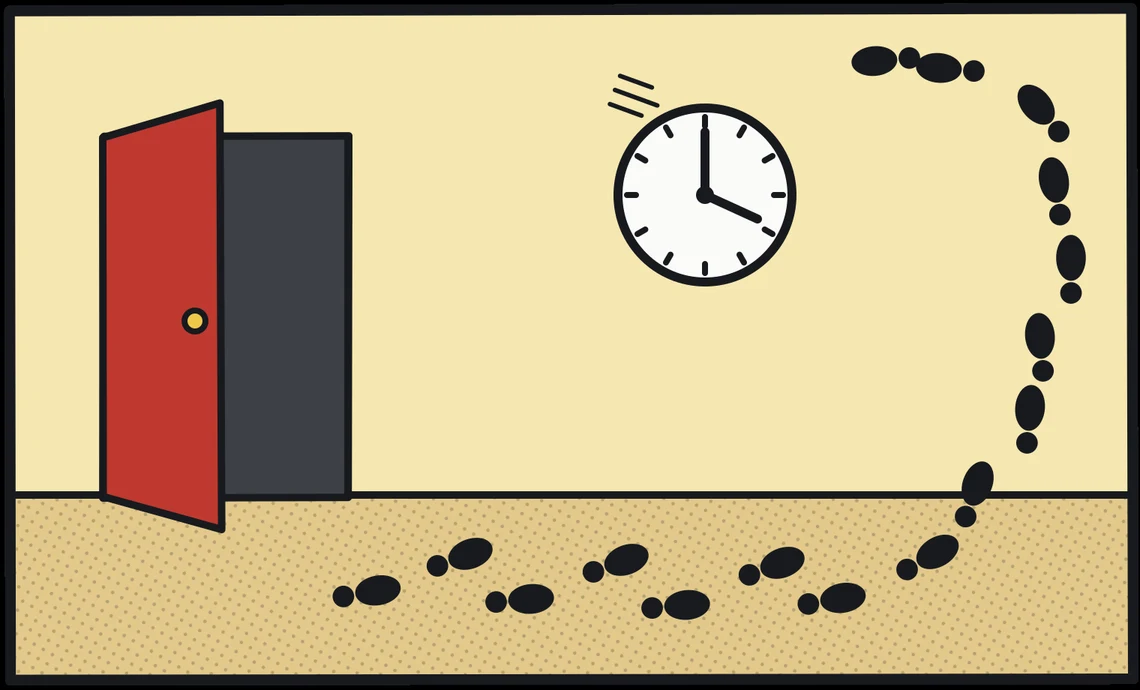
On 28 February 1957, issue 985 of the Belgian weekly Spirou carried a small, wordless figure with no name and no job, filling empty space on the page. The teaser was built by Franquin, his assistant Jidéhem and the magazine's editor Yvan Delporte, whose own looks are said to have given Gaston his face.
Gaston turned up hired, mysteriously, as an office junior at Spirou's own offices. Every strip after that is the same refusal: he naps, cooks and invents things on office hours while his boss shouts and nothing changes. A businessman keeps arriving to sign a deal with the magazine, and never manages it. When a contract does get signed, Gaston destroys it by accident.
Laziness was a legal problem. France's law of 16 July 1949 on publications for young people banned any picture or story présentant sous un jour favorable le banditisme, le mensonge, le vol, la paresse
: showing banditry, lying, theft or laziness in a favourable light. Spirou sold in France. Franquin made idleness lovable on those pages anyway.
On the grid, the gag is about control. Gaston sits at the very bottom of the office hierarchy and declines it.
1996 · the will
The one ending he asked for.
In August 1996, a few months before his death, Franquin gave a radio interview in his studio near Brussels.
« Ne faites jamais dessiner Gaston par quelqu'un d'autre ! »
“Never have Gaston drawn by somebody else!” — said of what he would put in his last wishes.
« Je n'aimerais pas du tout faire dessiner Gaston même par un très bon dessinateur. »
“I would not like it at all, having Gaston drawn, even by a very good artist.”
André Franquin, radio interview, August 1996, as reproduced by RTBF (source 4)
His daughter and sole heir, Isabelle Franquin, says he expressed that wish all his life, de manière continue et répétée
: that Gaston should not outlive him sous le crayon d'un autre dessinateur
, under another artist's pencil. Franquin died in January 1997. For more than twenty-five years, nobody drew a new gag.
1987–2016 · the chain of title
Follow the paper. Ownership moves. Control turns into a form.
Copyright here comes in two parts. The economic rights can be sold: they are the site's ownership axis. The moral right, under Belgian law, cannot be sold: it stays with the author and then the heirs, and it is the closest thing a character has to a control axis. Press a year.
Owns him · economic rights
Decides · moral right
The publisher's editorial director said in 2022 that Franquin had been paid plusieurs millions d'euros
for the 1992 contract, which allowed a continuation. That figure is the publisher's account of it.
2022 · the birthday
A hundredth birthday needs a headline act.

- 17 March 2022At the Angoulême comics festival, Dupuis and Dargaud-Lombard announce Gaston's return as the centrepiece of the centenary, drawn by the Quebec cartoonist Delaf (Marc Delafontaine).
- 28 March 2022Isabelle Franquin goes to court. Her case in one line:
Les droits moraux sont inaliénables.
Moral rights cannot be signed away. - Dupuis's caseIts editorial director:
les droits du personnage appartiennent à Dupuis
, the rights to the character belong to Dupuis, under a sale contract that allowed a continuation. - 13 May 2022Comics authors, Brussels names among them, including Frédéric Jannin, Philippe Geluck, Dany and Benoît Peeters, sign a petition asking Dupuis to
respecter la volonté d'André Franquin que Gaston Lagaffe ne soit pas repris par un autre auteur
. - 16 May 2022In emergency proceedings before the Brussels court of first instance, pre-publication is suspended and the publishers undertake to publish nothing until a private arbitrator rules.
30 May 2023 · the ruling
Lawful in principle. Not without her. On a form.
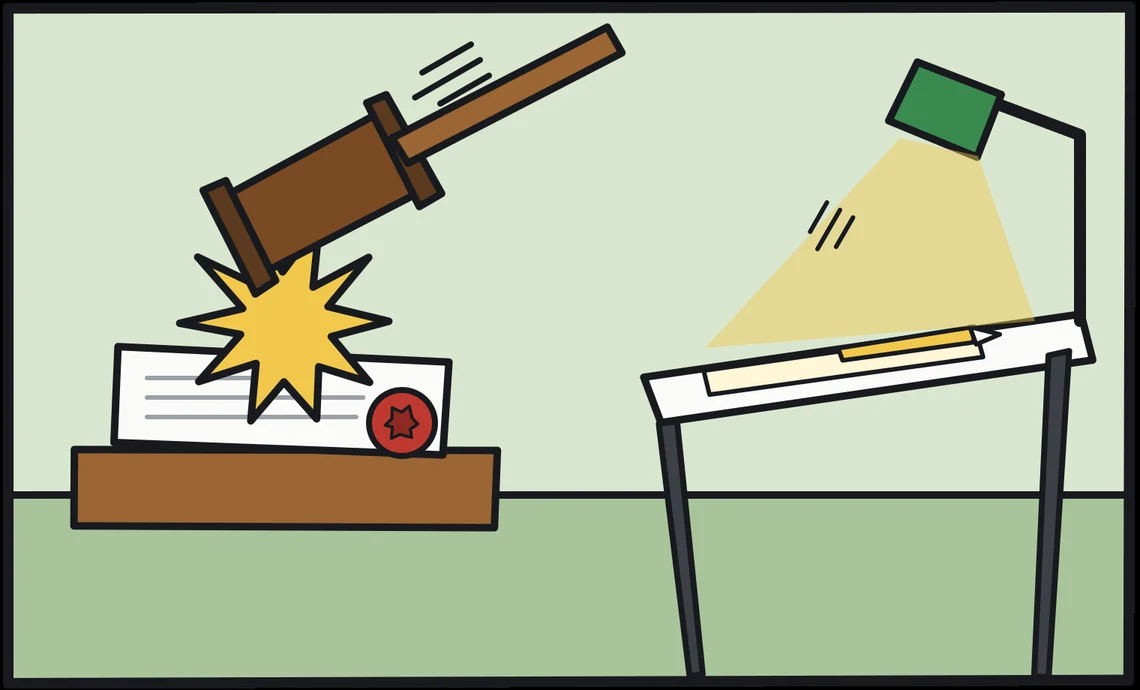
A Brussels lawyer chosen by both sides ruled as arbitrator. There is no appeal.
- OwnershipBringing Gaston back is lawful in principle: the 1992 contract with Franquin's company permits the new use.
- ControlOnly
à condition de solliciter l'approbation préalable d'Isabelle Franquin
, after seeking her prior approval, under the procedure agreed in 2016, covering the content and the choice of artist. - The limitA refusal
doit être justifié par des motifs éthiques ou artistiques
: it has to rest on ethical or artistic grounds. - The breachThe publishers had not followed that procedure. They were to inform her of projects every six months; her lawyers said this one was kept from her for five years, and test pages reached her only in December 2021.
- The restShe had not abused her moral right. The publishers' claim for damages was rejected. Costs were split fifty-fifty.
Ownership got the right to bring him back. Control got a veto, with conditions, on a form.
2023–2026 · the silence
She won the right to approve. Approving was the one thing she couldn't do.
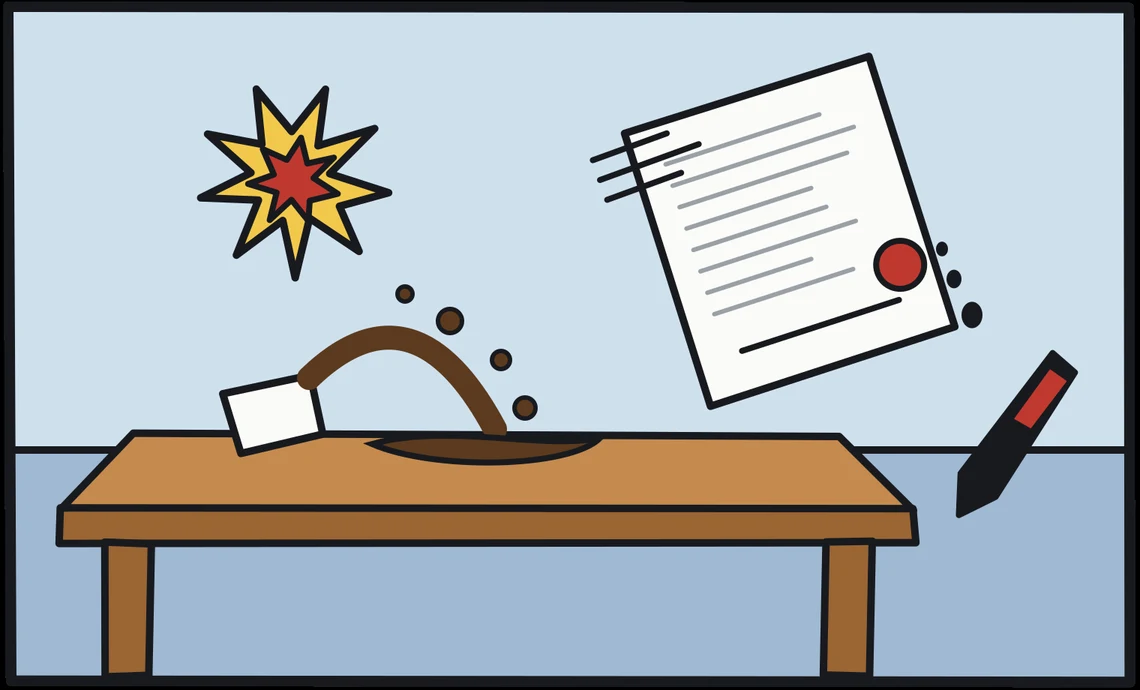
Le Retour de Lagaffe, volume 22, drawn by Delaf, went on sale on 22 November 2023, printed at 800,000 copies. The day before, Isabelle Franquin told ActuaLitté:
« Après réflexion, j'ai donc pris la décision de ne pas faire de commentaire au titre du Droit Moral sur l'album. »
“After reflection, I have therefore decided to make no comment on the album under the moral right.”
« Je ne puis aller contre la volonté de l'auteur. »
“I cannot go against the will of the author.”
Isabelle Franquin, 21 November 2023 (source 9)
Her lawyer gave the reason: commenting aurait constitué une forme d'aval à cette entreprise de résurrection de Gaston
, would have been a form of endorsement of the resurrection. Approve the pages or send notes on them, and she is helping another pencil draw him. Silence was the only refusal left.
The album series kept going. Volume 23, Des boum et des paf, written by Lewis Trondheim and drawn by Delaf, came out on 21 October 2026 with an announced print run of one million. Trondheim's own comment: Isabelle Franquin a le droit de les critiquer
, she has the right to criticise them.
The punchline
In the strip, the contract was the joke: the document that never got signed. Outside it, signed paper is what brought him back.
Ownership can be sold, and whoever buys it decides whether the character works again. The moral right can't be sold, and it still ended up as an approval procedure inside the buyer's contract, usable only on ethical or artistic grounds. Gaston dodged work for forty years. It took a company's hundredth birthday to put him back on shift.
The other half of the story
La Paresse: the 1949 law, Delporte, Franquin and their contemporaries.
How a French law against making laziness look good shaped what a Belgian comics weekly could print, and how the people at Spirou worked around it.
Read La Paresse →Sources
Every date and quotation, linked.
- Gaston (comics), Wikipedia: first appearance in Spirou no. 985, 28 February 1957; Delporte and Jidéhem; the office junior, the businessman's contracts; strips 1957–1996.
- Gaston, un rebelle en espadrilles, Centre Pompidou magazine: the anti-hero who questioned hierarchy and constraint; Delporte as editor-in-chief.
- Loi n° 49-956 du 16 juillet 1949 sur les publications destinées à la jeunesse, Légifrance; original article 2 wording as reprinted in La Revue des livres pour enfants no. 282 (BnF).
- Un nouvel album de Gaston, un crime de lèse-Franquin ?, RTBF, 17 March 2022: the August 1996 radio interview.
- Marsu Productions, Wikipedia: founded 1987 in Monaco by Jean-François Moyersoen; Gaston's worldwide rights added in 1992; bought by Dupuis in 2013.
- 100 bougies pour Dupuis, Gaston revient à la vie, Livres Hebdo, 17 March 2022: Angoulême announcement, 1.2 million copies, 19 October 2022, Dupuis founded 1922. Also ActuaLitté, 17 March 2022: Delaf; Isabelle Franquin informed four months earlier.
- La justice belge suspend le nouvel album de Gaston Lagaffe, ActuaLitté, 16 May 2022: inalienable moral rights; Dupuis's position; Marsu's 2013 transfer; the undertaking not to publish; Franquin's repeated wish. Petition: BX1, 13 May 2022.
- Gaston Lagaffe reviendra, mais avec l'accord préalable d'Isabelle Franquin, ActuaLitté, 31 May 2023; Brussels Times, 30 May 2023; Livres Hebdo, 22 August 2023: the arbitration award.
- À la veille du retour de Gaston Lagaffe, Isabelle Franquin réagit, ActuaLitté, 21 November 2023; BX1, 22 November 2023: 800,000 copies; her lawyer's statement.
- Gaston Lagaffe : pourquoi cette 23e BD est un événement, Fnac L'Éclaireur, 20 October 2026; La Libre Belgique, 23 October 2026: volume 23, Trondheim and Delaf.
An independent lesson. theaxes.fyi has no connection to Dupuis, Marsu Productions or the Franquin family. Quotations in French are given in the original with our translations.