The cartoon at the centre of this essay was unremarkable in its time. It was printed in a labour paper somewhere in North America around 1891, sold at a newsstand, dropped in a postbox, and delivered by a federal employee to a subscriber's tenement. Nothing about that sentence would have raised an eyebrow in 1891. Every clause in it has since been made strange.
Look at the cartoon. A top-hatted capitalist cranks a screw press. The barrel of the press is labelled, in the deliberate, didactic style of nineteenth-century political art: Capitalism. Monopoly. Autocracy. Wage-Slavery. The press grinds down on a wheel labelled Low Wages, which is itself crushing a slab labelled High Rent. Bleeding out from underneath the apparatus, his head and one arm visible, is a worker — labelled, with grim economy, Employee. Coins fall from his body onto the floor.
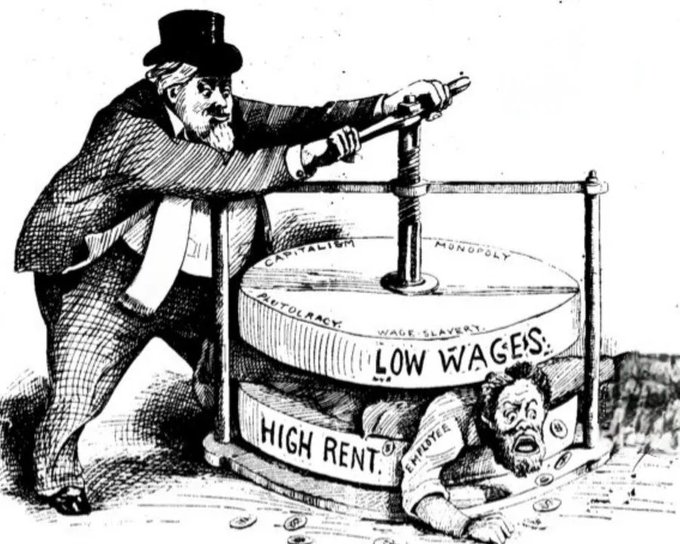
The cartoon is not the evidence. The cartoon's existence is the evidence. The question worth asking is not what it says — the message is obvious — but what kind of society permits this to be drawn, engraved, set in type, printed, mailed, and sold without consequence. That society existed. It is not the one you live in.
What the window contained, 1891
In 1891 the term wage-slavery was a literal description of an employment relation, used freely by labour editors, Knights of Labor organisers, single-taxers, anarchists, Christian socialists, populist farmers, and Republican congressmen. It was not a metaphor. It was a category. The argument was about whether wage labour was a transitional condition that would mature into proprietorship (the Lincolnian Republican view) or a permanent caste structure (the labour-radical view), but the term itself was uncontested vocabulary.
In 1891 the press ecosystem in which this cartoon could be printed included a Yiddish-language anarchist weekly that had launched the year before in Lower Manhattan, an English-language anarchist monthly out of London that had been publishing for five years and is still in print, a German-language anarchist daily that had survived its editor's deportation, an Italian-language anarchist press that would eventually publish thousands of titles, and a constellation of labour, populist, free-thought, free-love, single-tax, and Christian-socialist papers numbering in the thousands of titles across the continent. The mail system delivered all of it. Newsstands sold it. Public libraries shelved it.
Fraye Arbeter Shtime (Free Voice of Labor) — Yiddish-language anarchist weekly, launched 4 July 1890 in New York's Lower East Side, continuously published until December 1977. At the time it closed, it was the world's oldest Yiddish newspaper.
The 1891 Overton Window — meaning the range of positions that could be expressed in mainstream channels without professional, legal, or social consequence — included, as ordinary inhabitants:
- The labour theory of value, in both its Ricardian-classical and Marxian variants, taught uncontroversially in economics departments and accepted across the political spectrum from the editorial pages of the Chicago Tribune to the lecture halls of Yale.
- Land-value taxation as a practical reform programme. Henry George's Progress and Poverty (1879) had outsold every American book of the nineteenth century except the Bible. George nearly won the New York City mayoralty in 1886, finishing ahead of Theodore Roosevelt.
- Co-operative ownership of industry as a serious legislative proposal, advanced not by fringe radicals but by Granger and Knights of Labor candidates who held governorships, congressional seats, and the balance of power in multiple state legislatures.
- Free banking and the abolition of private banking monopoly, defended in the individualist-anarchist tradition by Lysander Spooner and Benjamin Tucker, and in the populist tradition by William Jennings Bryan and the Greenback movement.
- The general strike as a legitimate tactic, debated in mainstream pulpits.
- The eight-hour day — the demand that produced the Haymarket affair — which by 1891 was already winning legislative recognition state by state.
None of these positions was fringe. All of them are now either dead, criminalised, or so far outside mainstream political vocabulary that to articulate them is to be read as eccentric, foreign, or unserious.
The window did not narrow because anyone changed their mind. It narrowed because the speakers were removed.
How the window was narrowed
What follows is a chronology. It is not exhaustive. It is the spine of the operation by which the political vocabulary of 1891 was rendered unspeakable by 1925. The dates compress thirty-nine years of legal, postal, and immigration policy into the moves that did the actual work.
The cartoon is printed.
Distributed openly through the United States Postal Service. No editor is prosecuted, no printer is raided, no subscriber list is seized. The vocabulary of "wage-slavery" and "autocracy" is, at this date, ordinary American English.
Artifact 01Haymarket.
Four Chicago anarchists are hanged on the basis of speech and association rather than any proven act. A fifth dies in his cell. The trial is internationally recognised as a frame-up. The word "anarchist" begins its conversion from a political self-identification into a legal-criminal category that can be applied to a person without their having done anything.
Affeldt; Avrich; Knights of Labor archivesThe McKinley assassination.
Leon Czolgosz, whose actual connection to organised anarchism was thin and disputed within the movement, shoots President McKinley in Buffalo. The press treatment of Czolgosz as a representative figure of anarchism establishes the rhetorical template — "anarchism" as a synonym for unpredictable foreign violence — that will be relied on for every subsequent legislative restriction.
Anarchist Exclusion Act.
The first federal U.S. law to bar entry to immigrants on the basis of political opinion. Anarchism becomes, for the first time in American history, a category that can be used to exclude persons from the country.
Espionage Act.
Passed two months after U.S. entry into the First World War. Among other provisions, it grants the Postmaster General the power to refuse delivery of any publication deemed seditious. This is the mechanism that matters: the cartoon you are looking at reached its readers because the postmaster carried it. After 1917, the postmaster may decline.
Sedition Act and Immigration Act.
The Sedition Act criminalises "disloyal, profane, scurrilous, or abusive language" about the form of government, the flag, or the armed forces. The Immigration Act of 1918 extends deportation grounds to include membership in or affiliation with any organisation advocating the overthrow of the government — meaning that contributing to, editing, or printing an anarchist newspaper is, for non-citizens, a deportable act.
U.S. Statutes at Large; Immigration Act of 1918The Palmer Raids.
Under Attorney General A. Mitchell Palmer and a young J. Edgar Hoover at the Radical Division of the General Intelligence Unit, federal agents conduct mass warrantless raids on the offices of anarchist, socialist, communist, and labour-union organisations across the United States. By the end of January 1920, roughly 10,000 people have been arrested. The first wave is scheduled deliberately for 7 November 1919 — the anniversary of the October Revolution.
First Amendment Encyclopedia; 1914-1918-OnlineThe Soviet Ark.
249 people, including Emma Goldman and Alexander Berkman — the two best-known anarchists in the United States — are loaded onto the USAT Buford, nicknamed the Soviet Ark, and deported to the Soviet Union. The American state does not kill them. It delivers them to the Bolsheviks, who at that moment are preparing to crush the Kronstadt rebellion (1921) and the Makhnovshchina in Ukraine (also 1921), both anarchist formations. This is the move that requires the closest attention. It is not a side-effect. It is the operation.
U.S. Department of Justice deportation records; Library of CongressThe vocabulary is removed.
With the immigrant printers, editors, and contributors deported, postal exclusion blocking what remains, and the surviving organisations under permanent federal surveillance, the anarchist press ecosystem collapses as a mass medium. By 1925, "radical" in American English means "communist," not "anarchist." The libertarian-socialist tradition — Tucker, Spooner, Warren, the Liberty circle, the Haymarket martyrs' actual programme — is severed from the live political vocabulary and consigned to specialist historians, where it remains.
Why this looks designed
It is tempting to describe what happened between 1917 and 1925 as a controlled operation — a coordinated removal of one branch of the left to clear space for a more manageable one. This essay's companion piece makes that argument in its strong form. The short version is that three powers with three different reasons converged on the same outcome, and the convergence is dense enough that the question of intent matters less than the question of effect.
American capital preferred Marxism to anarchism because Marxism is statist: a Marxist revolution produces a state with which one can negotiate, recognise, sanction, trade, or eventually rehabilitate. (Nixon to Mao, 1972. Détente, 1969–1979. Most-favoured-nation status for China, 2000.) An anarchist revolution produces no counterparty.
The Bolshevik state preferred the elimination of anarchism for direct competitive reasons: anarchism contested the Bolsheviks' actual constituency — industrial workers, peasants, the dispossessed — with an incompatible programme. The Bolsheviks devoted significant resources to physically destroying anarchist formations from Kronstadt to Catalonia. Receiving Goldman, Berkman, and 247 others as deportees was, from Moscow's perspective, a transfer of dangerous personnel into a jurisdiction where they could be neutralised.
The American state, having defined "the left" as "communism," obtained a left that was simultaneously foreign (Russian), centralising, and materially traceable (party membership lists, financial flows, identifiable cadres). This is a vastly more containable opposition than a horizontally distributed, multilingual, immigrant-printer mesh of small papers and affinity groups rooted in domestic American soil.
Three actors, three reasons, one outcome. The question of whether this counts as a "controlled operation" is the question of how much coordination you require before you call something coordinated. The historical record contains no master document. It contains a set of decisions, each defensible in its own terms, which together accomplished the destruction of one political tradition and the elevation of another. That, in the precise sense, is the narrowing of the Overton Window.
What this means for the window today
Every Overton Window visualisation you have ever seen — including the ones on this site — has a problem. It plots positions against an implied centre, and the centre is whatever the mainstream press happens to be saying this decade. This makes the window look like a description of public opinion. It is not. It is a description of which speakers have been removed from the channels by which opinion is registered.
In 1891, the centre of the labour-press window included positions that the 2026 mainstream window does not contain at any density: that landlords are a parasitic class, that wage labour is a form of unfreedom, that monopoly is the normal endpoint of competitive markets, that the state is the executive committee of the bourgeoisie, that "free contract" between an owner and a starving worker is a fiction. These are not radical positions. They are the median positions of a press ecosystem that was systematically dismantled between 1917 and 1925.
To take the present-day Overton Window as a description of "what people think" is to ratify the outcome of the dismantlement. To take the 1891 window as a description of "what people thought before they were tricked" is to ratify a different myth — that people had to be tricked. Both framings miss the mechanism. The window is the residue of an editorial decision about who gets to speak in the channels through which "what people think" is measured. Once you see that, the question of where your opinions sit on the window becomes less interesting than the question of whose opinions the window was built to exclude.
The remainder of this series develops that question. The interactive comparison lets you place positions on the 1891 and 2026 windows side by side. The erased-axis essay makes the polemical case. The 1891 quiz uses period vocabulary to plot you on both windows simultaneously — most readers find they sit closer to 1891 centre than to 2026 centre, which is the point.